"Unlocking funds" (RESUMO do trabalho realizado
Macau’s early-stage investment fund industry is gaining momentum, driven by upcoming legislation, untapped capital pools, and potential regional co-operation with Hengqin — despite lingering structural challenges
By Tony Lai
While hundreds – if not thousands – of fund products are currently available in the Macau market, the vast majority originate from fund houses based in Hong Kong or further afield. This landscape only began to shift with the launch of the city’s first pataca-denominated, locally domiciled mutual fund by A&P Investment Fund Management Company Limited last year.
But the changes do not end there. The long-anticipated Investment Funds Law, set to take effect on 1 January 2026, is expected to inject fresh momentum into the development of Macau’s financial sector — particularly its nascent investment fund industry. This progress comes despite persistent structural challenges, such as limited financial literacy and legal-system discrepancies with other jurisdictions, among other factors.
Approved by the Legislative Assembly earlier this summer, the new legislation will replace the outdated Decree-Law No. 83/99/M, first enacted in 1999. The reform is part of the government’s broader strategy to diversify Macau’s economy beyond gaming and to foster the growth of finance, one of the four key non-gaming sectors identified in policy blueprints.
“The new law improves the framework for fund establishment, operation, and supervision,” said Simon Vong Sin Man, acting chairman of the Monetary Authority of Macau (AMCM), during a financial seminar in September. “It will better connect Macau’s fund market with international markets, enhance investor protection, and foster a more favourable environment for industry growth.”
The current legal regime has long been viewed as insufficient to support the demands of a modern financial industry, contributing to the limited presence of fund managers incorporated locally. To date, only two investment fund management companies — A&P Investment Fund Management and WI Harper (Macau) Investment Fund Management Limited — have received regulatory approval to operate in Macau, with the latter yet to commence business.
The revised framework introduces a broader array of fund structures, including contractual funds, joint-stock companies, and limited partnerships. It also provides clear definitions distinguishing between public and private funds, based on fundraising methods. Public funds, intended for retail investors, will require regulatory authorisation and be subject to stricter governance standards. In contrast, private funds targeting professional investors — defined as individuals with assets of at least MOP$8 million (US$1 million) and institutions with at least MOP$40 million — will only need to notify the regulator and will face a lighter compliance burden.
Re-domiciliation
One of the standouts of the new law is the allowance for foreign funds to re-domicile in Macau without forfeiting their legal status. The legislation also clarifies the roles and responsibilities of key stakeholders in the fund ecosystem, including fund managers, custodians, and distributors. For instance, banks and other financial institutions are also allowed to serve as fund managers, alongside dedicated firms.
“We have engaged with a number of investment fund management companies from Mainland China and overseas, many of which have expressed strong support for the new regulation and interest in the Macau market,” Mr Vong added. “Given the national policy backing and the government’s commitment to developing the industry, this is a prime opportunity for Macau’s financial sector to grow.”
One sign of this growing interest is the recent approval granted to Hengqin-based E Fund Management — one of mainland China’s largest public fund managers — by the China Securities Regulatory Commission to expand into Macau. If subsequently approved by the AMCM, it would become the first major mainland fund house to establish a presence in the city, potentially paving the way for more fund houses to set up here and further cross-border financial integration.
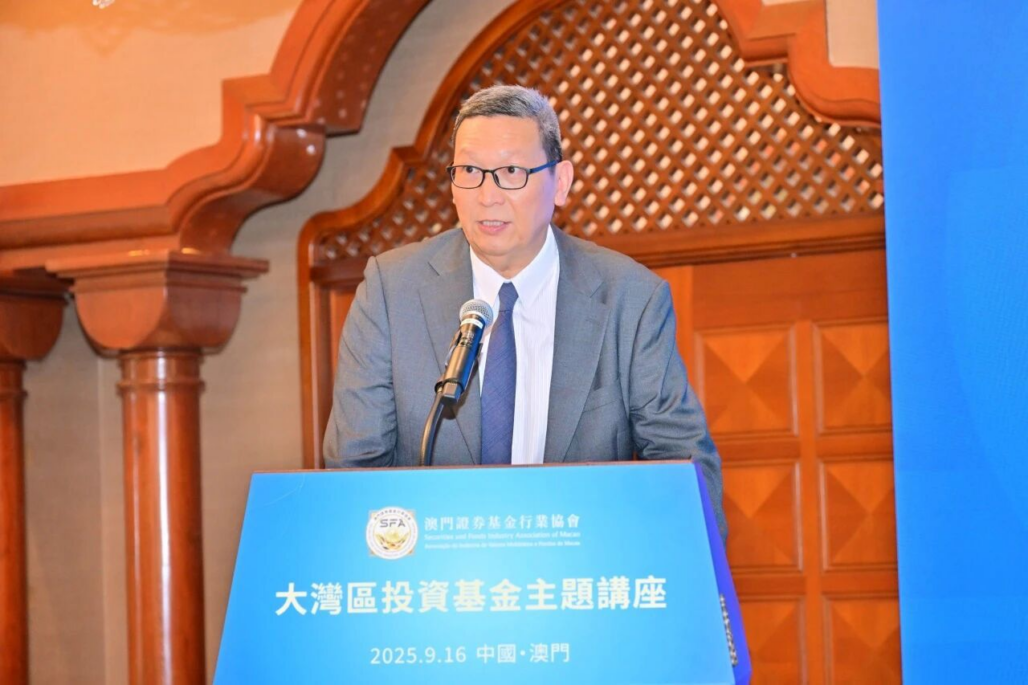
“[The new law] will better connect Macau’s fund market with international markets, enhance investor protection, and foster a more favourable environment for industry growth.”
Simon Vong Sin Man, acting chairman of the Monetary Authority of Macau
New capital, new opportunities
“The new Investment Funds Law reduces restrictions on private equity funds, with more relaxed rules on their establishment, fundraising, and supervision compared to the current system,” said Ip Sio Kai, a legislator representing the commerce and financial sector. “This aligns with international practices and is expected to attract fund management companies to Macau.”
The liberalisation of regulatory constraints is expected to encourage the establishment of new fund houses in the city, bringing in fresh capital and generating employment opportunities. In doing so, the law not only supports the development of modern finance in Macau but also opens up new financing channels for other sectors of the economy.
Mr Ip, who also serves as president of the Macau Association of Banks, highlighted that Macau’s competitive advantages — including a low tax regime, free port status, and unrestricted capital flows — create a favourable environment for fund management firms and related entities. However, he cautioned that the attractiveness of Macau as a fund domicile will also depend on practical considerations.
“Whether fund management companies choose to set up in Macau will depend on factors such as the efficiency of government approvals, operational feasibility, and their expectations,” he added.
In anticipation of rising industry demand following the law’s implementation, the Macau government has pledged to expand local training initiatives. Other manpower initiatives include attracting Macau residents working abroad in related industries back to the city. Labour importation will be considered selectively, based on the scale of investment funds and the overall pace of market development in the territory, the government added.

“There’s about MOP800 billion in fixed deposits held by the general population [in Macau], so naturally, fund managers around the world are paying attention.”
A&P founder and chairman Bernardo Alves
“Compared to Shenzhen and Hong Kong, where the markets are deep and investors are highly knowledgeable, Macau still faces challenges in financial literacy. There’s a need to educate the public that investment funds are not inherently risky.”
A&P founder and chairman Bernardo Alves
More rules and guidelines needed
Local legal professionals have also weighed in on the implications of the new legislation. A team led by Rui Pinto Proença at MdME Lawyers noted in a recent publication that the law achieves several key objectives: aligning Macau’s regulatory regime with international supervisory standards, enhancing investor protection, and lowering barriers to the establishment and operation of fund management entities.
“The [law] provides a robust and adaptable structure that meets international standards, aiming to make Macau an attractive hub for investment fund domiciliation,” they stated.
While the law establishes a comprehensive new framework, much of its practical effectiveness will hinge on the roll-out of secondary legislation. Legal experts Pedro Cortés and Calvin Tinlop Chui of Lektou law firm noted that supplementary rules and regulatory guidance from the Monetary Authority of Macau (AMCM) will be crucial.
“These rules are expected to be developed over the next 18 months, with ongoing consultation involving industry stakeholders,” the lawyers said in a recent written opinion, adding these rules and guidelines will cover areas like prudential ratios, investor qualification thresholds, and other technical matters. “Timely and pragmatic rulemaking will be critical to realising the law’s objectives and ensuring Macau’s competitiveness as a fund management center,” they remarked.
Furthermore, the two experts underlined that the new regulatory regime aligns with international standards, including those of Hong Kong, Singapore, the European Union, and the International Organization of Securities Commissions (IOSCO). This alignment, they argue, supports the development of an investment fund ecosystem in Macau and potentially streamlines cross-border compliance, paving the way for future mutual recognition or passporting arrangements, which would allow funds to operate across jurisdictions with a single regulatory approval.
“This positions Macau to compete regionally for fund origination, administration, and distribution flows,” they stated. “The success of this legislative overhaul will depend on effective implementation, supervisory pragmatism, and continued engagement between regulators and market participants.”

Untapped capital
One of only two licensed investment fund management companies in the city at the moment, A&P Investment Fund Management made history in July 2024 by launching Macau’s first pataca-denominated fund — the A&P Macau Patacas Money Market Fund. After its first full year, the fund achieved an annualised yield of 2.98 percent and reached assets under management of MOP318 million, marking a milestone for the city’s nascent investment fund sector.
Reflecting on the impact of the upcoming Investment Funds Law, A&P founder and chairman Bernardo Alves said the legislation represents a “significant step forward” for Macau’s financial industry, as it introduces a broader range of fund structures and offers greater flexibility in designing products tailored to investor needs. “A successful fund ecosystem requires more than just fund managers — it also depends on custodians, brokers, and other supporting service providers,” he noted, underlining the importance of a full financial services infrastructure to support the industry.
He believes Macau holds strong potential to attract fund managers and related companies, driven in part by its substantial pool of domestic capital. “I’ve spoken with external fund managers, and the main draw is the untapped capital in Macau,” he said. “There’s about MOP800 billion in fixed deposits held by the general population, so naturally, fund managers around the world are paying attention.”
Indeed, data from the AMCM, the city’s de facto central bank, supports this view. As of July 2025, resident deposits rose nearly 10 percent year-on-year to MOP817.3 billion. Non-resident deposits also saw a 7.5 percent increase, reaching MOP364.1 billion, while public sector deposits grew 8.5 percent to MOP210 billion. In total, deposits in the local banking system stood at MOP1,391.4 billion, denominated primarily in Hong Kong dollars (46.4 percent), followed by US dollars (24.3 percent), pataca (19.1 percent), and yuan (8.6 percent).

Financial literacy and government support
However, unlocking this capital for investment funds requires more than regulatory reform. “Compared to Shenzhen and Hong Kong, where the markets are deep and investors are highly knowledgeable, Macau still faces challenges in financial literacy,” the A&P founder and chairman said. “There’s a need to educate the public that investment funds are not inherently risky. There are various fund structures designed for different investor profiles and age groups.”
Beyond legislative changes, he stresses that proactive government support will be critical to nurturing a sustainable fund management industry. “In other jurisdictions—whether it’s Singapore, the US [United States], or Hong Kong—the government plays a crucial role in allocating capital to local fund managers,” he said. “Hong Kong is a prime example, where around 80 per cent of pension funds are managed by locally established institutions.”
The Macau government has pledged to launch two new funds following the set-up of the new law: an industrial investment fund and a technology guidance fund. These initiatives are intended to support the broader diversification of the economy away from gaming. The government is expected to take a leading role in both, with participation from gaming operators. Key aspects of the two funds — such as fund structure, scale, governance, investment types, and risk management — are still under discussion.
Yet even with strong policy support and legislative reform, structural challenges remain. One of the core issues is the divergence between Macau’s legal system and those of other financial centres.
“Macau operates under a civil law system, whereas Hong Kong and Singapore follow common law,” Mr Alves explained. “This difference makes it challenging for some firms to fully understand our legal framework. While entering the Macau market is possible, it might take months for firms to fully assess the legal and compliance risks.”
Cooperation with Hengqin
The development of the financial industry within the Guangdong–Macau In-depth Cooperation Zone in neighbouring Hengqin is also expected to play a supporting role in Macau’s efforts to diversify its economy and build a modern financial services sector. Jointly governed by Guangdong and Macau, the zone has become a fast-growing financial hub, offering synergies that could bolster the development of Macau’s nascent fund industry.
As of end-August, licensed asset managers based in Hengqin oversaw more than RMB6 trillion (US$842.75 billion/MOP6.8 trillion) in assets, ranking the zone fourth nationwide behind Shanghai, Shenzhen, and Beijing. The region currently hosts around 500 private equity fund managers, collectively managing over RMB680 billion in assets, placing it fifth in mainland China by that metric.
Speaking at a financial seminar in September, Chi Tenghui, director of the Financial Development Bureau of the Hengqin cooperation zone, highlighted the region’s accelerated financial growth and its strategic positioning in supporting Macau’s financial ambitions. The proximity, regulatory coordination, and capital scale of Hengqin are seen as key enablers in Macau’s push to develop the fund industry.

Takes time
The forthcoming Investment Funds Law further expands the scope of permissible activities for fund managers. Beyond collective investment management, the new law authorises managers to provide various services, including discretionary portfolio management, liquidity solutions, and hedging.
Even ahead of the law’s formal implementation, A&P Investment Fund Management has begun exploring new product concepts and structures, apart from the A&P Macau Patacas Money Market Fund, to test the market’s appetite for more sophisticated investment instruments. “For example, we have been testing out the hedge fund structure in Macau,” said Mr Alves. “We’re trying to understand what types of instruments are accepted, not only by the general public but private investors as well.”
While momentum is building, he cautions that developing a fully functioning fund management ecosystem will require time and continued effort. He welcomed the clarity and structure introduced by the new law but emphasised that legal reform is only the beginning. “The government has taken the first important step by implementing clear rules [because] transparency and clarity are essential,” he added.
https://www.macaubusiness.com/unlocking-funds/

Comments
Post a Comment